029 20 30 40 50
Puerto Rico and Venezuela: the Monroe Doctrine in action
Like a name dropper at a party, Donald Trump likes to associate himself with famous forerunners. In his inaugural address in January, it was the 25th US president, William McKinley. Earlier this month, he issued what he called the ‘Trump corollary’ to the Monroe Doctrine on the 202nd anniversary of the fifth president asserting US continental hegemony. Quoting James Monroe’s message to Congress that ‘the American continents… are henceforth not to be considered as subjects for future colonization by any European powers,’ Trump said: ‘With those mighty words, every nation knew that the United States of America was emerging as a superpower unlike anything the world had ever known.’ The Monroe Doctrine, he continued, is being ‘reinvigorated by my Trump Corollary’ and US leadership in the Western Hemisphere is ‘coming roaring back stronger than ever before.’
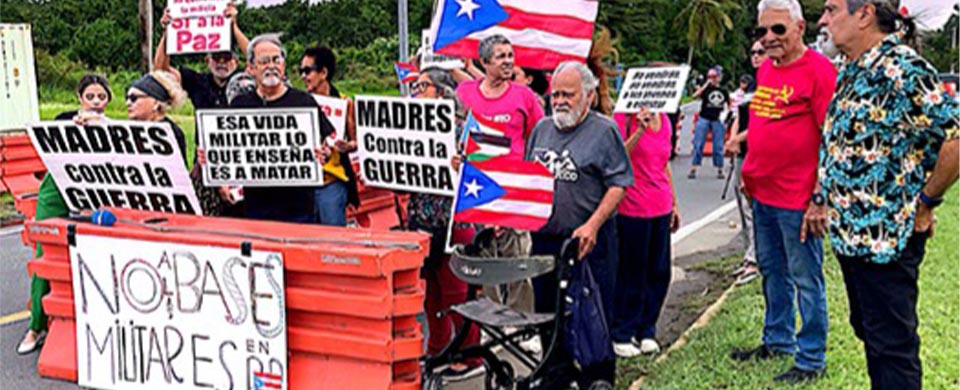
Roaring is the word. In Puerto Rico, the sound of F-35s landing at the Roosevelt Roads airbase is the fearsome manifestation of Trump’s words. In September, in the early build up for a possible attack on Venezuela, the Pentagon deployed the B version of the jet to the base. Last week, it reinforced them with F-35As, which have a longer range and can drop 2,000-pound bombs on their targets rather than the measly 1,000-pounds carried by the Bs. Given there are no F-35s aboard the USS Gerald R. Ford, the huge aircraft carrier Trump has sent to the Caribbean, the deployment to Puerto Rico underlines the island’s role as a staging post for a possible attack on Venezuela.
Still poverty-stricken and powerless, Puerto Rico is a tragic case study of the reality of the Monroe Doctrine. When Monroe issued his edict in 1823, the US lacked the naval capacity to enforce it. By the time McKinley became president in 1897, the US was ready to take on Spain and did so the following year with clinical efficiency in a war that lasted only sixteen weeks and included invading Puerto Rico. Under the subsequent peace deal with Spain, the Treaty of Paris, the US kept the island, ousted Spain from Cuba and also gained Guam and the Philippines.
Washington was clear from the outset that Puerto Rico would not be treated in the same way as the land it had conquered through Westward expansion. A Supreme Court ruling designated the island an ‘unincorporated territory’ and used the term ‘foreign in a domestic sense’ to describe how it would belong to the US without being part of it. Puerto Ricans did not gain US citizenship until 1917 when it conveniently boosted First World War conscription.
By the time of the Second World War, Puerto Rico had become a vital source of personnel. With some 65,000 of them having served, many Puerto Ricans saw it as payback time. The signing of the Atlantic Charter by the US and Britain in 1941 had given hope that independence was on the horizon. It declared that the two countries would ‘respect the right of all peoples to choose the form of government under which they will live’ and that they wished ‘to see sovereign rights and self- government restored to those who have been forcibly deprived of them.’
As with the Monroe Doctrine, however, US anti-colonialism was a one-way street: it saw the Atlantic Charter as being aimed at the empires of the European powers, not its own colonies. Even Rexford Tugwell, a liberal who President Roosevelt had appointed Puerto Rico’s governor, urged Puerto Ricans not to demand something the US would not give them. In his annual address in February 1944, he warned that Washington could penalise Puerto Rico financially if it broke away and said that ‘fairness’ requires the US Congress to offer in a plebiscite only ‘the choices it is willing to accept’.
Puerto Rico’s military value to the United States had by this time gone far beyond the supply of conscripts. Thousands of families had been cleared from the islands of Culebra and Vieques to make way for bombing ranges and Roosevelt Roads had been built as an airbase and to provide anchorage for the US Navy’s South Atlantic Force.
The pro-independence parties were divided, but Washington had an ally in Puerto Rico’s pre-eminent politician, Luis Muñoz Marín. When Puerto Ricans were allowed to elect their own governor in 1948, Munoz Marin won with a promise to secure a ‘free association’ with the US that was presented as the best of both worlds: self-government with the supposed economic benefits of the colonial link.
This ‘free association’ came, however, with the double standards that would epitomise the post-war ‘rules-based’ order. In negotiations on the new arrangement in 1950, the US refused to allow international observers to monitor a plebiscite that was due to be held to accept or reject it. Seeing the direction of travel, nationalists mounted a revolt, but it was swiftly defeated by the FBI and the US military. Afterwards, thanking Muñoz Marín for his co-operation, the FBI assured him that ‘due to the strategic importance of Puerto Rico…it was recognized in Washington that needs for personnel in Puerto Rico should be given priority attention’.
Initially, the US left it to Muñoz Marín to suppress anti-colonial opposition using legislation known as ‘the gag law’. As the Cold War proceeded, however, he became increasingly reliant on the FBI deploying the repressive tools devised for the red scare in the US itself. Communists were indicted and imprisoned, HUAC held hearings in San Juan, and COINTELPRO — the FBI’s covert programme for disrupting and dividing progressive organisations — was rolled out to ensure that plebiscites held in the 1960s delivered the desired results.
At the same time, the economic benefits were short-lived. The model implemented by Muñoz Marín was a prototype for what we would now call neo-liberalism. New Deal public investments were privatised, and growth relied on attracting inward investment by offering US corporations tax incentives and cheap labour.
Operation Bootstrap, as it was called, increased US domination and the flow of profits, interest, and dividends out of the island. Since the 1980s, around a third of Puerto Rico’s gross national product has gone to non-residents every year. In cash terms, the surplus leaving the country in 2024 was £40.2 billion — enough in one year to halve the debt that triggered a default in 2015 and the imposition of direct control over Puerto Rico’s finances by a US-appointed board. Meanwhile, more than twice as many Puerto Ricans (39.6 percent) live in poverty as in the US’s poorest state, Louisiana (18.9 percent).
The sorry saga of Puerto Rico’s ‘free association’ with the US provides a small foretaste of the bigger disaster that awaits Venezuela if Trump succeeds in overthrowing President Maduro. His favoured replacement, Maria Corina Machado, plans to privatise the country’s assets in a $1.7 trillion sale that would be the ‘single biggest economic opportunity for decades to come in this region.’
No doubt some Venezuelans, weary of nearly a decade of US sanctions that have driven oil production down by 75 percent, find Machado’s sale of the century appealing. As in Puerto Rico, however, any short-term benefits will soon be wiped out as US corporations extract a return on their investment and a new regime, imposed by force, will show its true anti-democratic colours. It’s just another Monroe Doctrine scam — and the world must stand with those resisting it.
Steve Howell
This article was first published by Tribune on December17, 2025.
Note: My next book, ‘Cold War Puerto Rico: Anti-Communism in Washington’s Caribbean Colony’, will be published by the University of Massachusetts Press on May 1, 2026. The book is already available for pre-order through major retailers such as Barnes & Noble and Waterstones. The recommended retail price for the paperback is $34.95 but UK pre-orders via my website are at the special price of £20 including postage. The publisher is also offering a 20% discount for pre-orders via their website by using the code UMASS20.